
2026-11-07T01:23:51.82+00:00
BBL and Liposuction Results: How Much Volume and Size Can You Achieve in New York?
Dr. Ronald Espinoza · 5 min read
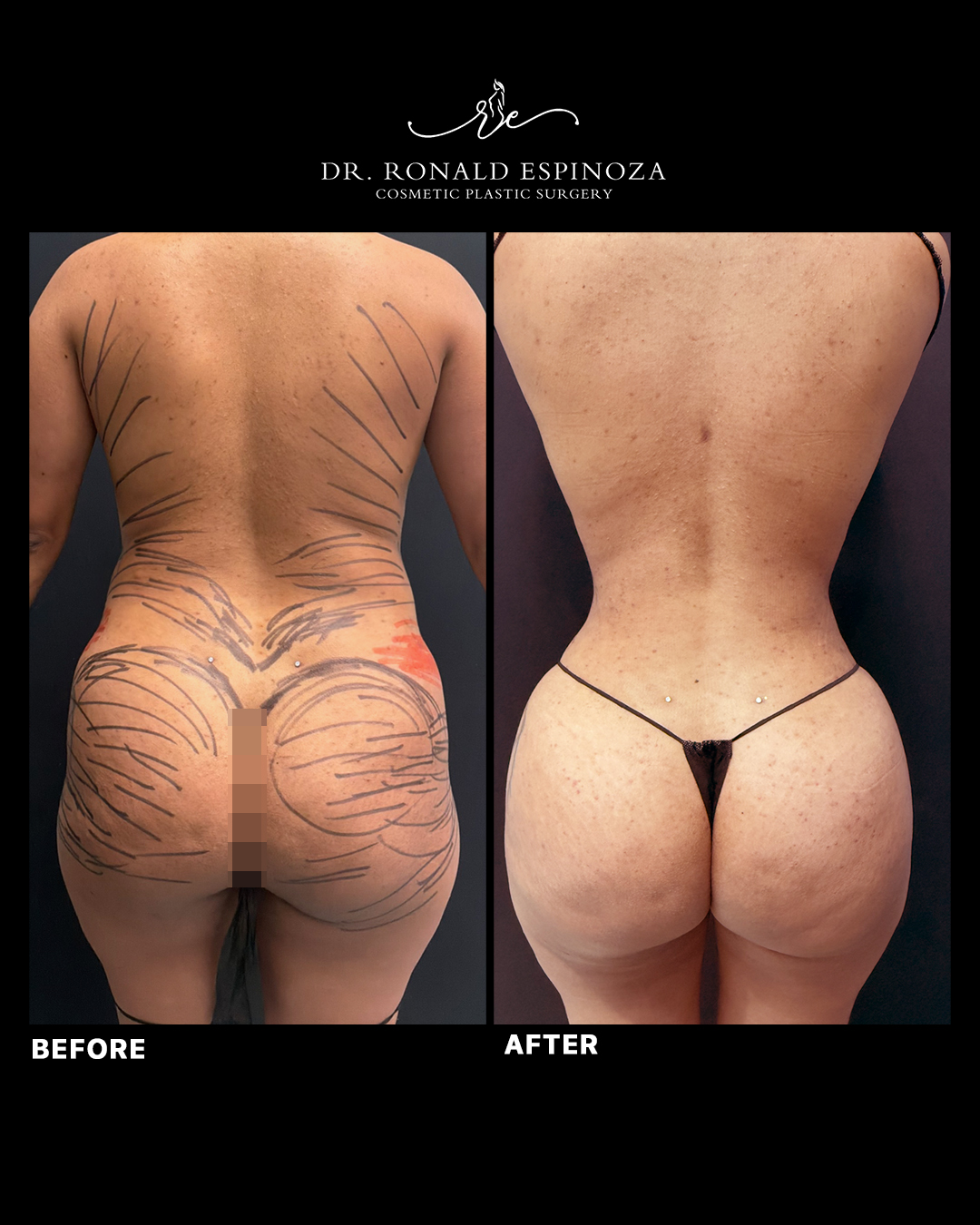
When planning body contouring, one of the most common questions prospective patients ask is how much volume and how many clothing sizes can realistically be gained through a Brazilian Butt Lift (BBL). A BBL combines 360-degree liposuction with autologous fat transfer, reshaping the waist, flanks, and abdomen while enhancing buttock projection. For patients visiting our practice in New York, the procedure is customized to balance natural anatomical proportions with noticeable, elegant enhancement.
Understanding Volume and Clothing Sizes in Brazilian Butt Lift Surgery
Patients often visualize their surgical goals in terms of pants sizes or cup sizes, but plastic surgeons measure fat grafting in cubic centimeters (cc). Converting cubic centimeters directly into dress or trouser sizes is not an exact science because every body distributes volume differently, and clothing brands vary widely in their cuts.
On average, many patients experience an increase of one to two clothing sizes following a standard Brazilian Butt Lift. However, because comprehensive liposuction typically narrows the waistline and trims the lower back, many individuals find that their waist drops one or two sizes while their hips and gluteal projection expand. This dual transformation creates a more dramatic hourglass silhouette than volume numbers alone might suggest.
Typical Grafting Volumes
- Subtle, athletic enhancement: Approximately 250 cc to 400 cc of purified fat per side. This provides gentle fullness and corrects hip dips without dramatically changing clothing sizes.
- Moderate, classic projection: Approximately 400 cc to 700 cc per side. This is the most common range for achieving a noticeable lift and a defined waist-to-hip curve.
- Voluptuous enhancement: 700 cc or more per side, provided the patient has sufficient donor fat deposits and adequate skin elasticity to safely accommodate that volume.
How Much Fat Can Be Safely Transferred During Liposuction in New York?
In New York, patient safety guidelines and physiological limits dictate how much fat can be safely harvested and reinjected during an outpatient procedure. The total amount of fat available depends entirely on your natural donor sites, typically the abdomen, flanks (love handles), upper back, and thighs.
During the procedure, your surgeon extracts fat via tumescent liposuction, processes it to separate viable fat cells from fluids and oils, and systematically micro-injects it into the subcutaneous tissue layer of the buttocks. It is critical to recognize that not all harvested fat is suitable for transfer; generally, only about 70% to 80% of what is aspirated becomes purified graft material.
Anatomical Boundaries and Tissue Compliance
The gluteal tissues can only receive as much fat as their blood supply can support. Over-packing the subcutaneous space with excessive volume increases tissue pressure, which restricts blood circulation and causes transferred cells to perish. Dr. Ronald Espinoza evaluates your tissue compliance, skin tension, and donor fat reserves to determine the precise volume that will yield the safest and most reliable aesthetic outcome.
Fat Retention: Why Your Final Size Is Different from Day One
Immediately after surgery, your buttocks will appear noticeably larger than their ultimate healed size. This initial volume is composed of three elements: the transferred fat cells, local post-surgical swelling (edema), and residual fluids. Over the initial three to six months, this swelling subsides, and the body naturally absorbs a portion of the transferred fat.
Historically, autologous fat grafting yields an average retention rate between 60% and 80% of the injected volume. The cells that establish a direct capillary blood supply during the first six to eight weeks will survive permanently. These surviving fat cells then behave just like natural fat cells elsewhere in your body, expanding or shrinking with future weight fluctuations.
Factors Influencing Long-Term Retention
- Pressure avoidance: Sitting directly on the grafted area during the early weeks can compress developing blood vessels and decrease cell survival.
- Proper compression: Wearing an approved surgical garment (faja) controls swelling in donor areas without compressing the gluteal grafts.
- Nutrition and hydration: Maintaining a stable, nutrient-dense diet without intentional caloric deficits supports cellular revascularization.
- Smoking and nicotine: Nicotine constricts blood vessels and severely impairs fat graft survival, making strict cessation essential.
Navigating BBL Recovery and Travel Across New York City
Recovering from a combined liposuction and BBL procedure requires thoughtful preparation, especially when living in or commuting through the New York metropolitan area. From arranging transport home to managing follow-up visits, having a concrete recovery plan makes a substantial difference in your comfort and results.
Transportation and Transit Considerations
Because you cannot apply direct pressure to your buttocks for at least two to three weeks, navigating New York transit requires advance coordination. Patients should arrange private vehicle transportation rather than using subways or commuter trains immediately post-surgery. When riding in an automobile, you will need to utilize a specialized ergonomic BBL pillow that places your weight entirely onto your upper thighs, keeping your buttocks suspended in mid-air.
Consultation and Recovery Logistics for Local and Visiting Patients
Whether you reside in Manhattan, Brooklyn, Queens, or travel in from Westchester or Long Island, planning your post-operative environment is essential:
- Home preparation: Set up a comfortable resting area where you can comfortably lay prone (on your stomach) or on your sides. Ensure essential items are within arm's reach to avoid bending or twisting.
- Walking and circulation: Light walking inside your apartment or home is encouraged starting the day after surgery to promote healthy circulation and reduce the risk of deep vein thrombosis.
- Follow-up scheduling: Routine post-operative visits allow your surgical team to monitor incision healing, assess fluid resolution, and guide your return to daily activities.
Schedule your consultation with Dr. Ronald Espinoza
Dr. Espinoza and his team guide you through every step, from your first consultation to full recovery.
Request a consultation · Call (212) 299-9979 · See before & after results · Financing options

Frequently asked questions
- How many sizes will my buttocks increase after a BBL in New York?
- Most patients experience an increase of one to two clothing sizes in their hips and buttocks. Simultaneously, liposuction on the waist, abdomen, and flanks often reduces the waistline by one or two sizes, creating a more pronounced waist-to-hip ratio.
- What happens if I do not have enough donor fat for a full BBL?
- If you have a lower body mass index, your surgeon can evaluate whether 360-degree liposuction across multiple areas—such as the inner thighs, arms, and full back—can yield sufficient volume. If donor fat remains minimal, alternative contouring approaches or staged procedures can be discussed during your consultation.
- How do I travel home after my BBL surgery in New York City?
- You will need a designated adult to drive you home via private car or taxi service. Subway and public bus travel are not recommended immediately post-op. In the car, you must use a specialized BBL recovery pillow placed under your thighs so your buttocks remain elevated and free from direct pressure.
- When can I see my permanent BBL results?
- Initial results are visible immediately, but substantial swelling persists for several weeks. By three months, post-operative fluid resolves and surviving fat cells integrate into the tissue. Your final, permanent shape is typically established between six and twelve months after surgery.